|
Invasives
resemble
potatoes
The inedible Dioscorea
bulbifera or air-potato
was introduced as ornament from Asia,
writes Clewell in Guide to
the Vascular Plants of the
Florida Panhandle. However,
another authority says it was
introduced from Africa during the slave
trade, although native to Asia. It
seems to have found a home in
San Luis Park in Leon County. This is
about the size of a small
tangerine, and is of the yam
family. It is depicted as being
similar to kudzu in taking over large
trees in Florida, and is more and
more common. The University of Florids
suggests eradication measures be
taken.
|
|
 |
Deer's
tongue
used in
tobacco
Flowers of this genus
Carphephorus,
sometimes known as wild vanilla,
are members of the composite
family, and six species grow in the
Southeast, area, according to
Godfrey in Aquatic and Wetland
Plants of (the) Southeastern United
States (1981, University of
Georgia). These flowers were growing off
forest road 106 in the
Apalachicola National Forest and we
caught them in the setting sun.
It was written years ago that tons of
leaves of the species odoratissimus
were being collected
and sold for flavoring smoking tobacco.
That's what Duncan and
Foote said in the early 1970s in Wildflowers
of
the
Southeastern
United
States which was one of the
first handy
guides to wildflowers in this area of
the country.
This is species paniculatus,
and was growing along with the odoratissimus
which has broader leaves at the bottom
and
pseudoliatris with very narrow
leaves. Such
flowers grow in pine savannas and
flatwoods from North Carolina through
Florida's peninsula.
|
|

|
Butterfly's
proboscis
Sipping nectar from a daisy in Liberty
County is one of the many
species of sulphur butterflies on the
Eastern seaboard. There are 300
species worldwide and 37 in North
America and Canada, according to Rick
Cech in Butterflies of the East
Coast: An Observer's Guide (2005,
Princeton University Press). Hibridizations
are many. A
butterfly's feet have chemical receptors
that react to sweetness and
the proboscis uncoils. Nectar is drawn
up by suction created by action
of muscles in the head, according to
Cech. Only a small part of a
butterfly's life is spent as an adult.
|
|


|
Sunset
for the
humming
birds
Autumn sunsets in the Big Bend area of Florida are
distractingly
beautiful
especially if you are out in the open and away from
the power lines.
We were trying
out our new Nikon D40x digital while the sun made
its exit over the
forest near Sumatra.
The camera allows for sepia tones, which accounts
for the picture at
the top. With the bright background, it was not
possible to retain the
colors in the foreground. The human eye can do this,
but can't focus on
the sun for long.
The second sunset was colorized with a change of
hues on the computer
It became a sunset for hummingbirds whose attraction
for the red
colors sends them to the red flowers,
How would an insect or a
bird view a sunset, with some limited capacity,
perhaps, to see the
colors?
|
|


|
Lake
Jackson
still retains
its flowers
While the lake waters are depleted by drought,
sunlight brings out
shades of yellow in the lotus blossom in Lake
Jackson in Leon County in mid-June.
The lake, which used to be one of the premier
fishing spots for bass in
the country, has suffered from years of low waters,
and development has
hedged around it. A recent zoning decision by the
Leon County
Commission, against all expert advice, showed a
willful and pathetic
ignorance of the natural value of the lake
The yellow lotus, Nelumbo
lutea,
is
the
only
lotus
native
to
The
United
States.
The
starchy
tubers
were
used
for
food by
native
Americans. Considered by some a
weed, it is endangered
in New
Jersey, eliminated by development in Delaware, and
threatened in other states. Lotuses are linked to
the Hindu goddess of
prosperity, Laskshmi.
Writes an
anonymous scholar,
"in esoteric Buddhism, the heart of the
beings is like an unopened lotus: when the virtues
of the Buddha
develop therein, the lotus blossoms; that is why the
Buddha sits on a
lotus bloom."
Also beautifying the lake were the white water
lilies Nymphaea
odorata which occur in
lakes, cypress ponds and coastal pools, writes
Clewell in Guide
to the Vascular Plants of the
Florida Panhandle. They float like bright
white candles on the
water.
|
|
 |
'Green
fly
orchid'
a jewel
This
orchid
blooms in June on hardwoods in hammocks,
sinks and gum swamps,
writes Andre Clewell in Guide to
the
Vascular Plants of the Florida
Panhandle. It grows in
Jefferson
County where we tied the camera to a
magnolia tree and pointed it
toward the flower. We've also seen it in
Falling Waters State Park. The
light passing though the petals shows
the fragility of the plant, which
often hides amid resurrection vine.
We've spied it on magnolia trees
above streams, where a micro climate
exists. The orchid is the only
arboreal orchid growing north of Central
Florida, and it grows in the
Southeastern states. The name is
now Epidendrum
magnoliae. It was once Epidendrum
conopseum before the
taxonomic change. It is said to give off
a sweet scent at night.
|
|
 |
White
spiderwort
is unusual
Along the St. Marks Bike Trail in
Tallahassee one may see a lot of
flowers, and some of them are unusual.
Common spiderwort, of the family
Commelinaceae, is usually blue.
This is probably Tradescantia
ohiensis which blooms
April through November throughout North
Florida. The color of a flower
is less important than the sum of all of
its other parts to botanists.
Soil conditions, for instance, might
have caused the plant to grow as a
white flower. The
plant is edible, and we
took this seriously and once
washed and chopped some in a household
blender and made some biscuits
out of it. It was sort of a slimy
emolient, in our estimation.
Well, no one much liked the green
biscuits because they
were excessively chewey. If one wanted
cellulose, however, there would
have been nothing finer to munch on. It
is said that spiderworts detect
radioactivity and were used by Native
Americans in a medicinal way.
|
|
 |
Guarding
the dunes
at St. George
The beach morning glory or Ipomoea
imperati is an important part of the dune
life on barrier
islands. It criss-crosses the dunes and helps to
keep them stable,
along with such plants as the sea oats. This flower
is widespread in
the United States, growing as far west as Texas and
up to North
Carolina on the coast. It has also been found in
Pennsylvania.
The plant curls up in the early evening when it has
had enough sun. The
leathery, shiny leaves reflect the sun, and thus
keep the plant from
burning in the heat of the day. This flower was
growing in abundance on
the dunes at St. George Island accompanied by other
flowers such as
fogfruit and yellow asters.
We went to the beaches to learn about the importance
of barrier islands
in a class at the Apalachicola
National
Estuarine
Reserve which safeguards 247,000 acres and was
established as a federal/state partnership with the
National Oceanic
and Atmospheric Administration and the Florida
Department of
Enviromental Protection.
Their program of estuarine education is multi-fold
and open to the
public. It was a great learning experience.
|
|
|
Gonolobus
twists upward
This unusual green flower, penny-size,
is a
beautiful climbing milkweed threatened
in Florida. Alexander
Krings of North Carolina
State University, a molecular
researcher, identifies it as
Gonolobus suberosus. Studies
have shown it distinct from
Matelea, as it was formerly known as Matelea
gonocarpus as well as Matelea
suberosa. Found
in many counties in
North Florida in rich woods, it twists
through the forest and up tree
trunks. Linda Chafin in the
Field
Guide to the Rare Plants of Florida
also lists the endangered Florida
spiny pod or M. floridana with
purple-black
flowers, Carolina
milkvine or M.
flavidula wth green or yellow
net-veined flowers, M.
balwiniana with
white flowers, and sandhill spiny pod
or M.
pubiflora with dull
brown-purple flowers. The last is a
trailing vine. A photo
below by Robin Kennedy is of the
rare Matelea
flavidula.
|
|
  |
Rare
passion
flowers
These rare variations grew along US 27
near Attapulgus, Ga., in May
2007,
just north of Florida. Passiflora
incarnata usually has only
three stigma, or female parts.
These flowers have four stigma.
The
arrow points to one of the four stigma
and its style, or tube, which
goes to the ovary. The stigma, which
receives
pollen, is on the outward end of the
style. The leaves of these and the
regular flowers in this patch were were
edged in red, the tendrils
were red -- quite atypical -- and
fruit was ripe two months earlier than
in N. Florida. Passiflora
Society members say that four
styles sometimes occur in incarnata. One
grower
found four styles from seeds
he originally got from Georgia.
Variability of flowers is a
secret of success where natural
selection favors the
flower with better reproductive
adaptation.
|
|
|
Thistle
prepares
to 'fend
the lave'
Reaching
out
for
a
thistle
can
be
painful
if
one
encounters
the
spiny
bracts
first,
but
there is a lot of beauty to see.
Of family Asteraceae, they grow
everywhere. This
one was aptly named Cirsium
horridulum by Michaux whose
book with this
flower came out in 1803. Thistles
attract bees, butterflies
and other insects who navigate easily
into the flowerhead when it opens
like the universe expanding.
Horridulum are either yellow or
purple.
This grew in a limestone glade in
Gadsden County,
and it seemed to
be thriving. They grow in flatwoods
and ruderal areas April through
August,
according to Andre Clewell in Guide
to the Vascular Plants of the
Florida Panhandle. The
thistle is the national emblem of
Scotland. The poet
Dunbar wrote Thistle and the Rose,
about the
wedding
of Margaret, daughter of Henry VII, to
James IV of Scotland. 'Dame
Nature' is seen naming the flowers in
the fields:
Then called she
all
flowers that grew in field,
Discerning all
their
fashions and properties;
Upon the awful
Thistle
she beheld.
And saw him keeped
by a bush of spears;
Considering him so
able
for the wars,
A radiant crown of
rubies
she him gave,
And said, 'In
field go
forth, and fend the lave.' |
|
|
Thistle from
a bug's eye
Coming in for a landing on a thistle,
a katydid may not see what we
see. This abstraction of a thistle was
accomplished through undisclosed
means, but it was the thistle above to
begin with.
Those who study insect physiology
report that many insect species can
distinguish colors. Their compound
eyes not only have photopigments
sensitive to different frequencies of
light, but give them an
additional advantage in being able to
see behind themselves, something
humans cannot do without mirrors.
It is reported that butterflies are
able to see colors better than some
other insects. Insects can see
especially the ultraviolets, greens,
and
blues. Even a caterpillar can
distinguish images.
|
|
|
'Tiger, tiger
burning bright'
From a distance, the
saprophytic orchid, Hexalectris
spicata,
is simply a purple spike with
flowers the size of a
strawberry. Up close, we see the
beauty. This flower dapples the woods
on rare
occastions in Florida.

"Hexalectris" means six
cock's combs for the
furls in the
lip. Spicata means "spiked"
for its spiked inflorescence,
observes
Carlyle Luer in The
Native Orchids
of Florida.
The red violet lip's fleshy ridges
loll forward. In
the center "reigns the arching
white-winged column with an orange
anther." The plant grows from
tubers, thick and closely jointed
which appear to be food
for rodents, writes Luer.
These
delicate flowers were seen near
Chattahoochee.
|
|

|
On the fringes
of existence
The
delightful and exquisite "fringed
campion" or Silene polypetala
can be found both
in central Georgia and North Florida
in a few sites. This perennial
herb is a federally endangered
species. It grows in wooded ravines
with
rich soil, alongside magnolias, tulip
trees and beeches. Daniel Ward of
UF suggests the correct name of the
plant should be Silene
catesbaei for Mark Catesby,
the pioneering botanist. North Florida
replicates the special more
northerly conditions under which this
and some other flowers, like the
mountain laurel, grow. It is found
near Chattahoochee, a city along
the Apalachicola River known for being
in or near one of the nation's
botanical hotspots for diversity. The
flower, about three inches wide,
is of the Caryophyllaceae.
Related
rarities
are
the
fire
pink Silene
virginica with red notched petals with only
one known location
in Florida in Bay County, according to the Florida
Natural Areas
Inventory, Silene
regia
with notchless red petals, and Silene caroliniana
with
white or pink flowers, in Jackson and Okaloosa
counties, respectively. |
|
 |
Coral
honeysuckle
makes visit
This flower is called in Latin Lonicera
sempervirens and was spreading its colors
along the roadsides in
North Florida in April and May.
We spotted it in Leon County. It is not an invasive
species, as is the
Japanese
honeysuckle, which tends to take over large areas,
and therefore the
red honeysuckle is popular as a garden plant.
We do not know the trick of getting the nectar out
of this flower, but
growing up we used to enjoy pulling the nectar from
the Japanese
honeysuckle.
It's hard to for us to consider the white flower
invasive, but those
more knowledgeable are quick to point out its
tendencies to take over
small areas.
The petals of the red flower open up in many shades
of yellow and red,
making a rainbow of color for anyone examining it
closely. It grows up
into the Great Smokies where it is known as the
trumpet honeysuckle. It
is a climbing vine with paired, oval leaves which
are white or whitish
beneath, according to Gupton and Swope in Wildflowers of the
Shenandoah Valley and
Blue Ridge Mountains.
|
|
|
Indian pinks,
Rose pogonia
with visitor
The
Indian
pinks on the left, or Spigelia
marilandica, are mid-spring
visitors along the forest
footpaths.
The deep red and chartreuse flowers
stand out like bright crayons. They
enjoy shaded areas, and we found
these as we walked along a park
trail in Gadsden County.
On the right is Pogonia
ophioglossoides, pogonia
meaning 'bearded.' It is also
called the rose pogonia and some
call it 'the snakemouth orchid.' It is
said that the orchid may have
the scent of raspberries. This beautiful
terrestrial orchid blooms in
mid-spring in the Big Bend of Florida
and is found
throughout the state. It is
related to the ribbon orchid below.
Dangling and waiting for prey is the
inevitable spider. It was found
along Highway 65 in Wakulla County.
|
|

|
Ribbon
orchid
shows off
This colorful orchid was seen in Wakulla County in
early May 2007.
There is scarcely a more
beautiful welcome for a pollinator, but beware of
the
spider. Delicately veined in a blend of crimson,
green and chartreuse, with sassy sepals, this
orchid is
related closely to the rose pogonia. It
ranges from the Southeast to
Texas. Luer writes of "a bluish green color with a
fine
frosty white coating reminiscent of a plum." Cleistes divaricata
is the old name
for the larger "spreading pogonia or rosebud
orchid." That orchid
is now known as Pogonia
divaricata.
The smaller flower is mostly white, while the
larger one is pink, says
Gil Nelson in Atlantic
Coastal Plain
Wildlowers. We
think this is the smaller Pogonia
bifaria. |
|
 |
Munch a
buncha'
colic root
This katydid has found a meal in the colic plant
that grows profusely
along Highway 65 in Liberty County. It was captured
in our flash on
slide film. How well the insect can climb is evident
from the hooks on
the end of its forelimbs. The rotating antennae and
the small wings for
guidance make the member of the grasshopper family
as truly efficient a
plant predator as can be imagined. There are some
6,800 species of
katydids known, and probably many more undiscovered.
Only 255 live in
North America. Some feed only on leaves and such,
which others are
predatory on their fellow insects, snails, or even
snakes or lizards,
say our sources. It is of the family Tettigoniidae
and these
are more closely related to crickets than
grasshoppers.
|
|
 |
Lady lupine
brings purple
to the woods
This is the lady lupine, or Lupinus
villosus,
a member of the pea family. This
silky-leafed species grows nicely in
scrub
and sandy soil, and provides great food
for caterpillars. It is common
in the Southeast, but is always a
pleasant surprise to see. The lupine
is the state flower of Texas, and the
species known as buffalo clover
sprouts oceans of blue. It is also
known as the Texas bluebonnet.
The Florida species pictured here shares
the characteristic flowers in
terminal racemes with a two-lipped calyx
and erect standard. There are
characteristically 10 stamens with
alternately long and short
anthers. There are 150 species of
lupines described for North
America, according to the popular
Wildflowers
of North America: A
Guide to Field Identification
by Golden field guides. We used a
Vivitar
19 mm wide angle lens on our Nikon
FE to capture this plant
growing along a forest road.
|
|
 |
Tulip tree
flower falls
into stream
This is the colorful flower of the Liriodendron
tulipifera, the American Tulip
Tree, which ranges from the
mountains to
central Florida and can grow more than
100 feet high. It is said that a
specimen, 450 years old, is the oldest
living thing in New York City.
The flower is a plentiful source of
nectar from which bees produce a
dark reddish honey. The tree, which is
mistaken for a poplar, is noted
for its soft timber. This magnificent
flower fell to earth in the
middle of a
stream in Gadsden County. The
blunt leaves are an easy identifier
for this tree.
|
|
|
Harper's beauty
is one of a kind
Why and
how this flower has survived over
millions of years in such small
numbers is one of the secrets that
nature keeps. It's the
only species in its genus.
Harperocallis
flava can
be
found
along
Highway
65
in
Liberty
County
and
a
few
other
places.
It
is
threatened and endangered, with
perhaps only a few thousand of these
flowers in existence.
Discovered in 1965, this member
of the lily family grows
in wet prairies and roadside ditches.
Spring mowing practices along the
road are monitored to protect the
plant.
Agencies are working together to try
not to destroy the plant's chances
to reproduce. It is a rhizomatous,
perennial herb and grows from 5 to
21 centimeters tall, according to the
U.S. Fish and Wildlife Service.
It flowers in May with one flower per
stalk and is leafless except for
tiny bracts, writes Linda Chafin in
the valuable Field Guide to the Rare
Plants of Florida printed
by
the
Florida
Natural
Areas
Inventory.
|
|
 |
Field of pink
sparkles
on
the savanna
Coreopsis
nudata
or swamp coreopsis is the tall
beauty in the Wilma
savanna in the Apalachicola National
Forest.
Swaying in the breeze,
these flowers paused to allow a
picture with an old but reliable
Contax
SLR with a 24 mm Sigma lens on it that
has a close focus. The film was Fuji
slide film, which normally
intensifies the natural colors.
Stopping the lens down, we were able
to get some
good depth of field.
It's pleasant to be out on the quiet
savannas. There is a song sung by
the Scarecrow in The
Wizard of Oz.
"I could while away the hours,
Conferrin' with the flowers,
Consultin' with the rain."
|
|
|
'Pinkroot'
on the
brink
of extinction
Two
treasures
are the orchid Platanthera
flava, left, which is seldom
seen and was found and photographed
at Wakulla Springs by Virginia Dell
Craig, a member of the Magnolia
Chapter of the Native Plant Society. She
also found the extremely rare
and U.S. engandered species Spigelia
gentianoides, or pinkroot, at
right. The delicate white flower
with pink
highlights is cousin to the red and
yellow Indian pinks that color the
forests in May. This flower, less than a
foot high, grows in Three
Rivers State Park, two miles north of
Sneads. The spigelia is a member
of a family with powerful medicinal
properties. This plant produces a
powerful toxin, but is yet to be tested
for medicinal properties,
according to the Center for Plant
Conservation http://www.centerforplant
conservation.org/ The
flava, left, can be found in
the Southern U.S., according to Luer in
The
Orchids of Florida. |
|
|
Indian cucumber,
wild camelia
Both of these beautiful and
rare-for-Florida springtime plants boast
purplish filaments and were blooming in
late April near each other in
sloping forests near
Chattahoochee.
The cucumber-root at left
or Mediola
virginiana, herbacious, has two
whorls of leaves with a
greenis hyellow flower held beneath the
leaves at the top whorl. It
grows from one to three feet high. It
was taken with flash beneath on
slide film in daylight. The tuber of
this plant is "crisp, wax-looking
and cucumber-flavored"
says Peterson's Field
Guide to
Edible Wild Plants. The blue
berries are not edible. The silky
camelia at right, or Stewartia
malacodendron, is a shrub or
small tree, growing sometimes to
about six meters, says Gil Nelson in The
Trees
of
Florida. It is rare in Florida
and grows on the slopes
of ravines. The mass of royal purple
filaments and creamy flowers give
the tree a
distinguished look. At first sight, it
looks like the
dogwood, but the flowers have purple
rather than green centerparts.
This is the first time we have seen
either plant, and this made our
day.
|
|

|
Flavidula
looks fancy
up close
This fancy-looking endangered vine, much enlarged, Matelea flavidula,
is found in
limited numbers in North Florida. These flowers are
actually only a little wider than your finger, they
grew on their vine
in a stream
bottom/edge.
Andre Clewell in Guide
to the
Vascular Plants of the Florida Panhandle writes
that the plant
gows on bluffs in Gadsden County and blooms in
July. Alexander
Krings at North Carolina State University says this
flower has a
well-developed gynostegial corona and its corolla
lobes are plane, not
wavy, differentiating it from Matelea
alabamensis.
Robin Kennedy took the
picture with a Nikon digital SLR, accompanied
by other members of
the Magnolia Chapter of the Native Plant Society. It
was
growing in a mixed pine/hardwood forest that had
been logged several
years
ago. The ground cover was predominantly grass, and
other neighboring
plants were Indian Pink, buckeye, dogwood, Robin
reports.
|
|

|
Mountain
laurel is a
treat here
One of the treats of springtime
is the mountain laurel in March
through April from Escambia County to
Leon County on bluffs and in
creek swamps. Considered rare in
Florida, some of the evergreen
plants grow as high as 10 feet. Their
branches are full of blossoms.
The mountain laurel has a hidden trick.
The anthers are set in pockets and
spring loose to dust visiting
pollinators that go after the nectar,
thus propagating the species. It
has a high drought tolerance, which puts
it in good stead in the
current drought in 2007 in Florida. We
did not need to go far to find
this flower, which was blooming in
thousands at the Maclay Gardens
State Park in Tallahassee. It is a
native American plant first recorded
in 1624, named after Pehr Kalm who sent
a sample to Linnaeus many years
later. It is said that native Americans
made spoons out of the wood,
and there were other uses for it. |
|
|
Betony
more than
another
'weed'
Stachys floridana, a member of
the mint family. has a long
list of purported uses as an herbal
remedy. It is said the roots
are edible in salads, but don't take our
word for it. Betony was a
remedy "for all maladies of the head
including hysteria." Worn as a
necklace, the plant wards off evil
spirits, ancient writers believed,
according to our sources at
botanical.com. A physician of the
Roman emperor Augustus said it cured 47
diseases and dispelled evil --
as well as protected the wearer from
"visions and dreams." This,
at purplesage.org.uk. The flower is a
weed to many people. It provides
a nice landing place for insects.
Hundreds of plants were growing in moist
soil near Lake Hall at Maclay
Gardens. It is found on disturbed or
ruderal ground
throughout Leon and other counties. Gil
Nelson in East Gulf Coasal Plain
Wildflowers
writes that the related Stachys
crenata is critically imperiled
in Florida. |
|

|
Serenade
in the key
of gold
No flower as appeals to our senses as
does the golden azalea. We
breathe deeply
and they are more fragrant than
honeysuckle. We sit beneath the azalea
branches on a hill above the small
rippling stream at the Angus Gholson
Nature Park. Perhaps
it
is
possible
to
live
up
to
the
challenge
of
John
Muir
who
wrote
-
"'Most people are on the world, not in
it --
having no conscious sympathy of
relationship to anything about them- undiffused, separate, and
rigidly alone like
marbles of polished stone, touching but separate.'
Nature
furnishes
the
opportunity
for
everyone.
Florida
flame
azaleas
are
found
from
Escambia
to
Leon
County,
although
we haven't heard of them growing
wild
in Leon County since 'progress' took
over. Native
Nurseries in Tallahassee is a great
place to look for wild flowers,
including Rhododenron
austrinum.
|
|
 |
Alabamense
endangered,
but keeps
appointment
Rhododendron
alabamense or
the Alabama azalea, is identified by the
lemon-yellow petal at the
top, differentiating it from the similar
pinkster flowers. Many
people in the the region
just
call wild azaleas "wild honeysuckle."
This species grows in hammocks in
Leon and Jefferson Counties in April,
writes Clewell. It may also
be
found as far north as Tennessee and west
into Mississippi. First
described in 1883, the flower is said to
have a lemony scent, and
we
did note that it shared the
distinctive flavor of several of the
other
members of its family. It takes an
insect to tell the difference.
We found these flowers in abundance at
Maclay Gardens. We are eager
to find them growing outside of a
garden.
|
|

|
Forget-me-not
recalls a tale
of fated love
It's a small flower steeped in legend
and tradition. Medieval legend
tells that a knight and his lady
strolled by the water. He picked a
posy of flowers, but because of his
heavy armour he fell into the
river. As he was drowning, he tossed the
posy
to his beloved, shouting
"Forget-me-not!" The flower is also worn
in
memory of those killed in wars, and as a
sign of
faithfulness. It is said to have a
Christian religious
connection also. Myosotis
macrosperma is a member of
the Boraginaciae with 100 genera and
2000 species, 19 indigenous
to the United States, writes Lawrence in
Taxonymy
of Vascular Plants.
Myosotis is cultivated for ornament.
This plant was thriving in Gadsden
County in
March in forest shade and is common in
the eastern U.S. It
is
relished
by
caterpillars.
|
|
|
Adventurer
found this
forest fern
Usually smilax is a pest with sharp
thorns and tendrils, but Smilax
ecirrhata (at left) greenbrier
or
upright
carrion
flower
is
an
exception. This
plant is a widespread member
of the lily family, but was not in
bloom. The fern is Phegopteris
hexagonoptera or
'broad
beech fern.' Fronds are up to two feet
long.
These
ferns are widespread, growing as far
north as Canada. One ignores
the forest floor at peril of losing
sight of its richness. Each plant
contributes to the forest. The famed
French
botanist and brave adventurer Andre
Michaux
found the fern on his journey to America
to find trees
to replenish France's forests. He
explored Spanish Florida in a
dugout
canoe. A friend of William Bartram, he
could find plants
that Bartram overlooked, to Bartram's
amazement. |
|
 |
Crossvines
seem to
chat away
They seemed to be talking away on a road near the
Arvah Hopkins Power
Plant in Tallahassee. Strewn through the hair of a
tree, these flowers
on a vine were decked out for church and full of the
latest news. Turns
out the crossvine or Bignonia
capreolata likes the floodplains and
hammocks and will bloom
from March through April. Its corolla is
yellow-orange to red,
described by Andre Clewell in Guide
to the Vascular Plants of the
Florida Panhandle. This native vine is
widespread. It's terminal
leaflet is modified into a tendril.
The stem is separated
into four equal longitudinal segments which can be
seen as a cross
section, according to Richard D. Porcher in Wildflowers of the
Carolina Lowcountry
which is an excellent supplementary book for
Florida.
While they weren't growing in a floodplain, they
were along a ditch and
a stream that appeared to be taking water from the
power plant. It was
a good place for them, and they were prospering. The
related trumpet
vine or Campsis
radicans will
appear in
floodplains and disturbed areas later, and the Catalpa bignonioides
will also
flower.
|
|

|
Rare
violet
shows off
in Gadsden
This rare Viola hastata was
prospering in
solitary splendor near a remote
creek in Gadsden
County, amid trilliums and other spring
flowers. In Florida, the flower is
known only in
Gadsden County, according to Daniel Ward
in Rare
and Endangered Biota of Florida.
This flower is considered endangered. It
is the only violet
in Florida with a yellow flower,
according to Ward. It is known also as
the halberd-leaved yellow
violet. It was found along the Flat
Creek area
near Chattahoochee, amid
lance leaved trillium and other uncommon
species. It was
photographed with a Nikon FE
using Fuji Velvia 100. We
digitized on a
Coolscan V at 130 million
pixels before being reduced to 72 dpi.
The flower, which
usually blooms in April, is
apparently blooming several weeks early, not unlike
many plants adapting to what
scientists say are
global warming changes. |
|
|
Florida
violets
remind of
life's renewal
Pushing up through the
leafy debris
the purple violets sing a song of
rebirth and renewal, a gaudy
camouflage over the decay of the year
gone by, whether in meadow
or graveyard or our front lawns. They
are buttons on the earth's
overcoat, We see an abundance of
violets this spring, all marked
with a fancy landing path for insects
that will carry the pollen from
one violet to another. No larger than a
nickel, this violet dwarfs the
small plant to the left
which grows under the protection of the
leaf. This particular
violet was growing somewhere in
Jefferson County at the Letchworth
Indian Mounds park, and we suspect the
violets were growing when the
native Americans lived there from 200 to
800 A.D.
|
|
|
Orchid
makes
its own meals
without the sun
Spring coral root, or Corallorhiza
wisteriana, is a native
perennial orchid that can be found in
almost
every state of the union, but it is
little seen because it is often
hidden away in the shade. A saprophyte,
not a parasite,
it depends on mychorrizal fungi in its
roots to help it produce
nutrients. Vast network of fungi
underlie the
soils upon which the plant grows. Its
flower is smaller than a dime,
and glistens in the sun. Purple dots
adorn its lip. The flower was
discovered by the American botanist
Charles J. Wister and was named in
1833 by Rafinesque. It blooms in rich
mixed hardwood
forests and usually near trunks of
trees, in bunches. Whether
the underground rhizomes bloom every
year may be a function of how much
water was available over winter. This
coral root grew
along Thomasville Road in Leon County,
Florida, off a a side road in a
wooded lot.
|
|

|
'Cherokee
rose'
grew
where
tears fell
This rose with pure white
petals grows
along The Trail of Tears from Florida to
Oklahoma, says Indian Legend,
and sprang forth from the tears of
mothers who could not help their
children.
It was a sign the elders prayed for, and
gave the mothers hope.
The
center, a cluster of yellow stamens,
represents the gold taken from
Cherokee lands, says the Cherokee
Messenger on the Internet. It
drapes the trees along roadsides in
springtime Leon County. We climbed
through a briar patch right off Monroe
Street, a couple of miles north of
the Capitol. Scratched up,
but delighted to get the picture.
Georgia has deigned it the state
flower there. Rosa laevigata originated
in
China
and
Taiwan,
and
was
brought
to
the
U.S.
about
1780,
where
it
thrived
in
the
Southeastern U.S. , although it is
reported that early
explorers saw it in Indian villages. |
|
|
Trout
lily
dazzles
the eye
The Angus Gholson
Nature Park is an incredible place
to enjoy the early
spring
flowers, and these include colonies
of trout lilies which
spring up with their
mottled
leaves the colors of the brook
trout. Considered endangered in
Florida,
they bloom about
the same time as the trilliums. This
flower is also at River Bluff Park
on Highway 20. along a ravine
leading to Lake Talquin.
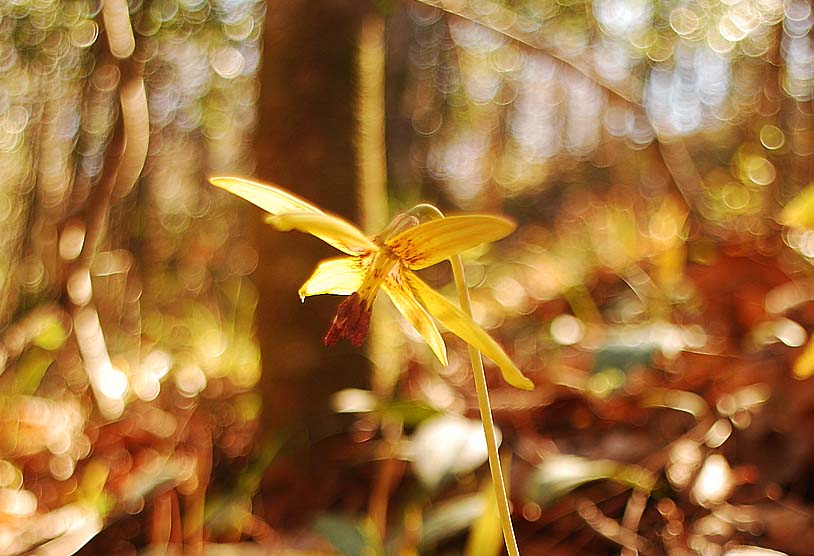
Erythronium umbilicatum grows as far
north as Canada. A member
of the lily family, it has three
petals and three
sepals that
look like petals. Picture
was taken with Fuji Sensia 100 slide
film and Nikon FE2 wih 50mm
2.8 macro lens.
Digitized at 130
million
pixels and reduced to 72 dpi in Adobe
Photoshop on our Mac G5. We
have not yet run out of slide film,
but occasionally look out
over the new digital cameras that
are coming out
|
|

|
Cat and mouse,
frog and lizard,
owl and pussycat
There are some noted pairs in the literature of
nature and of poetry.
In real life, Darwin wrote of cooperative behavior
among animals. Some
of this is evident in the warning calls that some
animals give when
predators are near.
When Gerald and Christl Grow went out to look at a
table on their deck,
they found that something had waddled through "a
mist of pine pollen"
and left suspicious tracks.
Detective work revealed that a tree frog and a
lizard had found a
comfortable perch in the pocket of their patio
umbrella. They share the
warmth, however humble the abode. At the same time,
they
probably keep an eye out for scrumptious insects
that may pass by
unsuspecting beneath the canvas. Whatever the
reason, the behavior
appears to be of mutual benefit for
the parties involved.
Photographs by
Gerald Grow.
|
|
|
Tiniest
orchids
spring forth
Two
North
Florida
Counties, and probably others, play host
to the delicate and
threatened twayblade orchids, so small
that they are easily
overlooked.
These, of course, are some of Florida's
terrestrial
orchids.
Left was photographed in Gadsden
County near
Chattahoochee in early March; right was
contributed by
Gerald Grow, author of Florida
Parks.
He found it growing in February in
Jefferson County. Both
flowers grew amid fallen leaves where
the soil is rich. Listera
australis blooms from
January to July, writes Carlyle Luer in
The
Native Orchids of Florida. He
writes that its "secretive habits" and
"tiny stature" make it rarely
seen by people.
Further
down in the page
are some wonderful
macro pictures of this
orchid taken by Patricia Stampe and
Robin Kennedy under
"Twayblade Orchid Is Threatened."
|
|
 |
Lance
leafed
Trillium
pushes up
This early flower, with
three
leaves and bracts, can be found on the
bluffs in Gadsden County in
February and March. It was growing amid
the atamasco lilies near the
Angus Gholson Chattahoochee Nature Park.
Its full name is Trillium
lancifolium and it is
considered threatened in Florida
according to Andre Clewell's Guide
to the Vascular Plants of The Florida
Panhandle, an essential
book for anyone who has a strong
interest in things botanical in North
Florida.
It is accompanied by large groups of
Trillium underwoodii, whose
rounder leaves are also considered
choice nibbles for animals and
insects. Normally, the underwoodii
bloom in late January or early
February, to be followed by the lancifolium.
Peterson Field Guides say that trilliums
are edible in salads, but we
will have to warn you that you can be
arrested for taking them out of
their natural habitat for those or other
purposes.
|
|
|
Slime
inches
its way along
along fallen
tree limb
"Slime" is actually
neither a plant
nor an animal, and is the least studied
of the five kingdoms of living
things - plants, animals, bacteria,
fungi, and slime. Scientists know
it is not a fungus, and that it eats
bacteria and other forms of
slime. It seems to be from an alien
world, and, indeed, inspired the
old horror thriller "The Blob" which
came out in 1958 starring Steve
McQueen.
This Gadsden County slime is some of the
likeliest slime we have
ever seen.
Coming in hot pinks, oranges and
yellows, slime oozes its
way across vegetation. It was dripping
its way down to the
ground. Slime molds are called
"myxomycetes" in the Kingdom
Protoctista. Slime shows intelligence,
and chopped up, seeks its
other parts and then go looking for
food. For more on this, please go
to http://www.smithson
ianmag.com/issues/2001/
march/phenom_mar01.php
|
|

|
Fern was in
space shuttle
experiment
The
"resurrection fern" enjoys a niche on the limbs
of oak and
cypress trees throughout the South. It is
crinkled and brown when there
has been no rain, but springs to life in the
dews and damps. Here, a
frond of Polypodium
polypodioides, perhaps six inches long,
catches the
rays of the evening sun at the Lee Vause Park in
Leon County. It can
survive for many years without water. At the
suggestion of a science
class, it was taken on
the space shuttle where it bloomed aboard the
craft.
It is an epiphyte and gets nutrition from
the air and rain and
from bark. You can see the sori or clusters of
spores.
Spores will float in
the air and attach to other trees, including
dead
trees. Great clusters of these ferns drape
entire limbs.
|
|
|
Solving the
'Love Bug' Problem
Shaking
out this pitcher plant Sarracenia
lutea
in a bog near Hosford,
one found it had devoured a
nice handful of
love bugs,
those pestiferous insects that have become
motorists' nightmare in
Florida.
Plecia
nearctica
blind drivers by
spattering
windshields, cause mechanical problems by clogging
radiators, and pit
the finish on cars unless they are washed off.
They swarm in April and May, and August and
September. Among
natural enemies are birds and some insect larvae.
If the roadsides in
the state were planted with carnivorous pitcher
plants, the sum of
happiness might increase for motorists and the
plants. Whatever
attracts the bugs to the pitcher plants
ought to be investigated.
|
|

|
Clathrus
has
own insect
attractant
Sprouting on the
winter
shores of Lake Jackson
in Leon County, this oddly-shaped fungus
is a species of Clathrus.
The mushroom guides tell us it is probably
Clathrus columnatus, known
as a "stinkhorn." It
has
a very powerful smell, somewhat like cow
manure,
which
attracts flies and other
insects.
This fungus is common
in the Gulf
Coastal region.
It was the only bit of color
springing up from the ground along
the lake,
which is
resuscitating from many months
of water depletion. It used to be one of the
best bass fishing
lakes in Florida.
Development has sprung up around it, and
pollution
has taken its toll.
The plant was about 4 or 5 inches high, and
"edibility is not officially known," but it is
hard to say who will
hold a fork to it. |
|

|
Last tango
in Sumatra
There
is
no
good
way
to
die,
but
it
has
been
said
that
the
most
fortunate
in
death are caught doing what they love
best. As if frozen
by the camera, this bee or bee fly is
perched on the petal of a purple
lobelia, gathering that last bit of
nectar for the day's rounds,
somewhere out in Liberty County. When we
became suspicious, we brushed
it off, and it fell to the ground,
mummified. Perhaps it had been
caught by a spider and poisoned, or
maybe it had reached old age, which
can't be long for most insects. Well,
the cold weather is coming and
the eternal timekeeper has put out the
warning signs for all creatures,
great and small.
|
|
aihoaihdoaaoao
|
 |
 |
jjjjjjjjjdihaoihaoifhaoihfa
|
|
'Shrooms
not on
our menu
The Fly Amanita is also known
as
the American fly agaric, or more popularly
-- the classic
fairy toadstool. As we drove along the road to
Bristol from Sumatra, we
saw it was thriving along the roadside. These
mushrooms are sizeable,
and
one often sees a group of them. These were shaded by
large trees, and scattered around were others that
had spread their
caps.
The mushroom springs up in several shades of orange
and its cap, when
spread full, is wider than an observer's hand. Noted
by the scales on
its cap, and pale flesh, the mushroom is known from
Alaska to Florida
to Siberia.
We found that this mushroom has no detectible smell,
and we learned
that it is poisonous.
Its
Latin name is Amanita muscaria.
A rule is never
to eat
any mushroom until it is identified as safe to
eat by a mushroom expert.
Two good beginner's books for Mushrooms are the
Eyewitness Handbooks Mushrooms by Laessoe and
Lincoff by DK
Publishing
and the Simon and
Schuster's Guide
to Mushrooms, edited by Lincoff. |
|
 |
False
foxglove
It is a delight to see this freckled, splashy,
handsome flower in the
woods and roadsides.
The Agalinus (spp) or false foxglove comes along at
the end of the
year. There are many species in our area, all of
them a delightful pink
or popsicle purple. This flower has been considered
a member of the
Scrophulariaceae or figwort family.
The true foxglove is also a member of this family,
which includes
snapdragons, speedwells, beardtongues, monkey
flowers. coral plant and
wishbone flowers, among others.
Most of them are garden ornamentals. Probably the
most noted of the
species is that of the drug plant Digitalis which
comes from the true
foxgloves.
Lawrence in Taxonomy
of Vascular
Plants says there are 210 genera and almost
3,000 species in the
family.
Gil Nelson in East Gulf Coastal
Plain Wildflowers says there are 20 species
in our area, and
because some are parasitic, they have been
reclassified into the
broomrape family.
|
|

|
Rayless
goldenrod
marks the
cooler
weather
Biglowia (spp) basks in
sunlight near Sumatra, Fla., south of
Hosford, on a forest
highway.
This flower prospers in wet meadows and
along ponds and ditches
and is
found along the Gulf and East coasts up to the
Carolinas.
This species
is most probably Biglowia nudata,
which
is
known
as
rayless
goldenrod.
The
setting
sun
causes
the
lens
of
the
camera
to bring a cascade of reflective light bubbles
down from the
sky.
We used our new standby Fuji Velvia 100 slide
film, that now has
supplanted the old Velvia 50 speed film. The
picture was taken with a
Nikon FE2 set on automatic, using a short macro
lens, and the slide was
digitized using a Nikon Coolscan V.
The amount of glass in the Nikon 2.8 macro
probably helped cause the
reflection that is seen in the picture. But
shooting into the sun with
any camera sometimes does bring some strange
effects. |
|
0.
|
Duck Potato
Attracts
Butterfly
North Florida is enjoying its autumn of
butterflies. This skipper extends its proboscis and
is sipping nectar
from Sagittaria
latifolia,
the duck potato, wapato or common arrowhead. When
not in use, the
proboscis is coiled up and not easy to see.
These plants are prolific along the roads in St.
Marks in Wakulla
County. Godfrey and Wooten in Aquatic
and
Wetland
Plants
of
Southeastern
United
States count 13
species of Sagittaria in the Southeastern wetlands.
The plant with starchy tubers can become
invasive in our swampy
areas. This plant has a three-petaled white flower .
According to
Peterson in Edible
Wild Plants,
the
butterflies
are
not
the
only
creatures
that
can
enjoy
this
plant.
The
potato-like
tubers
"are delicious when cooked" and can be
eaten just like potatoes.
With separate male and female flowers, this appears
female,
as illustrated in Godfrey. Foster and Duke in
the Peterson Medicinal
Plant book write that
Indians used tuber tea for indigestion and poulticed
wounds with
the tubers, and also used leaf tea for rheumatism.
|
|
|
Queen
of
the Night
The lavish night-blooming Cereus comes into flower
for one brief
night a year. A tropical cactus flower,
it climbs upwards into trees in South Florida,
and is also a popular garden
flower. It has been called the most beautiful flower
in the world. The
cereus has a perfume as
pungent and perhaps as pleasant as
jasmine. It's a flower that can grow more than a
foot wide. Usually one
may see many
blooms on this cactus, but each
one lasts only
until the morning hours. The
next night, others bloom. Vicki Cole, of
Tallahassee, an enthusiastic gardener,
brought her
outstanding cereus cactus to our attention. We
illuminated the flower
with
battery lanterns
and used Fuji slide film. Another excellent view of
a cereus can
be seen on Harry Levin's flower page. |
|
|
'Total
Protonic
Reversal'
The question of how insects
might look at
a flower is always puzzling, but it is known that
color plays a role.
We're purists about flowers, but there are days when
imagination takes
us to some other places. What if every tinge and
shade of one color
became another color? We recall Dan Ackroyd's great
line from the first
Ghostbuster movie. Total protonic reversal!
Doused with color through a set of computer
algorithms and then placed
into Photoshop for more cosmetics, the
night-blooming cereus eventually
becomes the Scarlett O'Hara of the garden. |
|
 "A species of
passion flower is common, reaching back into
"A species of
passion flower is common, reaching back into
Tennessee. It is here called 'apricot vine, has a
superb
flower, and the most delicious fruit I have ever
eaten."
-John Muir, environmentalist, walked
along the Savannah River in 1867.
A Thousand-Mile Walk to the Gulf (First
Mariner Books,
1998)
|
Passion
flowers
proclaim
summer
The discovery by the Spanish of a 'marvelously
stupendous' flower in the New World was met with
disbelief by the
Church, but it was soon adopted to represent the
Crucifixion.
Each part of the flower was seen as vital to the
story and used to
convert the Indians of South America, where the
sweet fruit
of the grenadilla is now part of the economy. The
tasty fruit of our Passiflora incarnata, growing in
a
field in Leon County, is about
the size of a
lemon, but those in Latin America can be as large as
a football.
Incarnata
is
one of 500 species. A must-buy is
the beautifully illustrated Passon
Flowers by John Vanderplank, MIT
Press.
See a
marvelous site at http://www.
passionflow.co.uk
We also offer a new view of
this
flower,
related to the mystic writings of Kabbalah. |
|
|
Little
'yellow
passion
flower'
The petite wild yellow
passion
flower
blooms in
Tallahassee in mid-July, a few weeks later than
its larger relative.
Enlarged here (it
is about an inch wide), the Passiflora
lutea
was
growing in
a tangle of smilax and
grape vines in northeast
Tallahassee.
The vines were
fruiting, but not yet mature. The fruit, an
achene, is
about the size of a small blackberry.
Nearby, between about 10
a.m. and 2 p.m., bloomed two beautiful
purple incarnata. They had not been
there
in the
morning.
The
lutea
prospers from
Pennsylvania to Illinois and Kansas, and south to
Texas and Florida,
writes John Vanderplank. It is one of he
hardiest passion flowers and the northernmost of
all species of
passionflower.
Not useful as an
ornamental, it is "an excellent candidate for
hybridization" according
to Vanderplank. It could give its cold tolerance
to the new flower.
The lutea
grows in at least
20 counties
north of Kissimmee, says USF's
Institute for Systematic Botany. The leaves are
three-lobed
and rounded. The three excellent close-ups were
taken by Robin Kennedy
using a Nikon D100 digital camera, and the
top right in a setting
is by M. Abrams. Click on any of these for a
larger picture. |
|
|
A
passion
for the flower
brings the bee
A
carpenter bee, covered with pollen, brushes the
anthers
a passion
flower in Leon County. The bee wants the nectar and
the
nectaries are located below
the anthers. But the secret is that in order to
reproduce, the flower must have pollen from another
flower reach its
stigma,
and so the bee unwittingly serves to transfer
pollen. One can see that
the three stigma of this flower, attached to
the round green ovary at top, have reflexed
themselves downward
in a reproductive mode.
These bees are sometimes
seen on
leaves, grooming and trying to brush pollen
away,
The carpenter bee does the work of the missing honey
bee. They
are solitary bees, and do not produce honey. Only
the female stings if
her nest is disturbed. These
bees will mostly avoid a flower
with another bee of its species who got there first.
But we have seen a
very large bee take over a flower and the smaller
one take a hint.
|
|
|
Spider lily
confused but
graceful
The graceful spider-lily is
a member of the Amaryllis family. Its fragile
translucent membrane
stretches to form a hexagonal corona from which
spring six fancy
gold-tipped
anthers and a longer green style.
The lily thrives in
wetlands and meadows. The number of species of
Hymenocallis is
confusing, but three species had been described in
the Panhandle up to
1985, Eminent botanist Robert K. Godfrey spoke of
taxonomic confusion
among experts,
but is
pictured standing amid a species named for him.
Author Gil Nelson
reports seven species in the Gulf area, but
cites
"many synonyms and imprecise names."
Richard Porcher, in Wildflowers
of the Carolina Low Country, sees
"confusion in the literature."
This flower, nevertheless, prospers on the James
Gadsden Highway near Sumatra in
Liberty
County.
|
|
|
Hurricane
lily was not
prophetic
Photographed along a rural
road near Quincy in Gadsden
County, these flowers are called 'hurricane
lilies' by the local people, says botanist Loran
Anderson. Their
pungent sweet fragrance attracts many insects. An
exotic species of
Crinum, this plant gets naturalized from Florida to
Texas.
It originated in tropical
Asia. The species is C. zeylanicum, also
known as the "milk and wine" lily.
In bunches like the amaryllis,
they are beautiful to see and a surprise
for anyone who comes across them in the wild. Now,
we know of at least
two species of flowers called "hurricane
lilies." The year 2006
was not prophetic for the hurricane lilies. |
|
|
Sunset
paints lady's tresses
with a glow
Twisting and turning in a
spiral of
small white flowers, Spiranthes orchids grow
throughout
the northern hemisphere in temperate zones. One may
even be
growing in your yard, and you may have mistaken it
for a weed.
Usually growing a little more than a foot high in
North
Florida, these land-bound orchids share the
characteristics of one of
the world's
largest families of flowers. Spiranthes is Greek -
"spira" meaning
coiled, and "anthes" meaning flower. Carlysle A.
Luer's The Native
Orchids of Florida has
many beautiful pictures of the species of these
flowers.
Luer cites
Darwin as explaining how the flowers procreate. The
flowers open first
at the bottom of the spike, and insects work their
way upward. A bee
collects nectar at the bottom and becomes laden with
pollen as he
progresses along the immature flowers to the top. At
the visit to the
next spike, the bee deposits the pollen on the
bottom mature flowers,
and works his way up, collecting more pollen for the
next spike.
|
|
|
Gladiolus
escapes
and thrives
Flaming red and yellow flowers were growing
along a lake east of
Tallahassee. The escaped gladiolus reverts to
its original colors in
the wild, according to Loran Anderson, FSU
botanist emeritus.
The gladiolus originated in Southern Africa and
is one of the most
widely used ornamentals. The
name gladiolus comes from Latin meaning "sword"
because of its long
stem. Say florists,
gladiolas tell the receiver that "he or she
pierces the the heart."
These are close to the Florida State University
team colors, garnet and
gold. Flowers once placed in gardens are
always ready to escape.
It is well
to keep in mind that all flowers were once
wildflowers.
|
|
|
Moths
keep
a home in
carnivorous
pitcher plant
Hidden
in
the white topped pitcher plant, Sarracenia
leucophylla, were two
moths, safe from everything except a
photographer. This carnivorous
plant, which drowns and then dissolves its prey,
also serves as a home
and a refuge for insects smart enough to figure
a way to cling to its
slippery sides without falling into the
digestive juices.
One of the moths flew out, and posed on the
ground for an instant,
before flying away in a series of zig-zags which
made it impossible to
follow through the air to its new destination.
Tom Miller, a professor at FSU who studies these
plants, says the moth
is probably an Exyra moth. This would also
explain the bent leaf,
writes Miller.
"The larva of this species "skeletonize" pitcher
plant leaves,
which often results in a rather misshapen
leaf." he writes.
"It is sometimes even called the pitcher plant
moth. Only larva hurt
pitcher plant leaves -- the adults seem to just
hang out in leaves."
Prof. Miller finds adults down the throat of Sarracenia flava,
although they are
perhaps best known for attacking Sarracenia
purpurea. He points out there is
also a picture of this
moth at http://natureinfocus.
com/articles/
mantis/mantis.html -- which, we
add, is a page at Billy
Boothe's incredible nature site.
Thanks, Prof. Miller |
|

|
Invasion
of privacy
in the bog
A solitary katydid nymph
finds a perch on the blossoms of Dionaea
muscipula, the Venus flytrap,
transplanted
years ago from coastal Carolina to a bog in
Liberty County, where it
grows in profusion.
This bug posed for a
few pictures. While we
don't want to attribute
human characteristics to insects (though
Spiderman and The Fly allow
insect and spider characteristics to be
attributed to humans) we must
say that
this katydid does look a bit disturbed about
being photographed.This is
a meadow katydid (that is, a small nymph of a
species of the
subfamily Conocephalinae) according to
University of Florida
entomolotist Thomas J. Walker.
Meanwhile, the plants have survived. New
pollinators have apparently
arisen to insure the flytrap's success
in Florida. Insect pollinators include the
leaf beetle below
identified by UF entomologist Lyle Buss as a
member of the family
Chrysomelidae.
This species of beetle
could be seen
on many of the flowers. Dusted with pollen, it
is
certainly of benefit to the plant.
Insects must tread carefully, as it must be
observed that one tumble
from the petal can result in
a cataclysmic death. The leaves of the plant
close in upon the the spider or ant, and don't
open until the creature
has been digested.
We have a movie on this website showing how
the plant traps insects.
The insects provide the nitrogen missing from
the
acid soil in which these carnivorous plants
thrive. They inhabit a
peculiar niche. How they evolved over eons to
depend upon trapping and
devouring insects is a question that we have
not yet seen answered.
|
|
|
Rudbeckia
dressed up
The customary cloak of scarlet of
Rudbeckia
graminifolia takes on a new
look through the magic of computer
algorithms. Who is to say what this
flower would look like to an
insect? Rudbeckia grows along roadsides
of The James Gadsden Highway in
Liberty County
and throughout the Apalachicola National
forest from spring to summer.
It is robed in royalty and is a gem of
the woods. Click on the real
picture to enlarge.
|
 |
|
|
Meadow
Beauty
brightens
the forest
The meadow beauty proclaims its presence as
eight golden anthers wait to
brush a pollinator, usually a bumblebee,
Such a bee vibrates the
pollen from the anther. Ten species of Rhexia
bloom in North Florida in
spring and summer, colors ranging from white to
pale pink to rose
purple -- and also yellow.
Leaves and tubers of at least one species,
Rhexia virginica, can be
used in salads and for nibbling, writes Lee
Allen Peterson in Edible Wild Plants. The ovary
is
shaped like a pitcher and when the flower fades
away, what is left
looks like a little red jug.
This
flower
is
probably
Rhexia
alifanus so named after a
town in Italy distinguished for its jugs, writes
Gil Nelson in East Gulf
Coastal Plain
Wildflowers.
|
|
|
Twayblade
orchid is
threatened
"Progress" and development in Florida have
endangered the Listera
australis or Southern
twayblade, shown here with stunning clarity.
Patricia Stampe and Robin
Kennedy found this orchid blooming at the Marianna
Caverns "in a leaf
littery kind of area," he writes. "They are almost
impossible to see
unless you know where they are. It was afternoon on
a sunny day. There
is black cloth in the background for the closeups to
make the flower
stand out from the leaf litter." A Nikon digital
camera was used.
Patricia took the picture to the far left. |

|
|
Ashe
magnolia
is ancient
The ashe magnolia with flowers the size of a dinner
plate, prefers the
rich hardwoods and dry ground. The tree or bush
grows up to
30 feet tall,
writes Linda Chafin in her Field
Guide to the Rare Plants of Florida. It
thrives in the wild in
North
Florida in ravines and on slopes, in the understory.
The ashe is
endemic to the Florida Panhandle, blooming several
weeks before the
Southern magnolia. Splashed with
purple, the plant has a fragrant smell. Magnolias
are
primitive plants with fossil remains of 58 million
years ago having
been discovered. The University of Florida IFAS says
magnolia
flowers are primarily pollinated by beetles of the
Nitidulidae family
because magnolias evolved long before bees and other
flying
pollinators.
A sugary substance subs for nectar. This plant
was
doing well in the garden at
the Tallahassee Museum of History and Natural
Science -- the
old "junior museum." It is found in about 90 sites
in Florida, writes Chafin. Magnolias were
named for Pierre
Magnol, a French botanist. |
|

|
 Florida
Wildflowers
Supports New Orleans & The Hurricane
Katrina Relief
Effort
Florida
Wildflowers
Supports New Orleans & The Hurricane
Katrina Relief
Effort
Click
Here
to get your own
Fleur-de-lis
|
|
 |
Wild
blue
irises have
a good year
A number of species of blue
irises can be
found
in North Florida, and it is not unusual to find what
look like
different species growing within a few yards of each
other. In iris
lore, the large and colorful "falls" are actually
the sepals.
There is some taxonomic confusion in the iris world.
Clewell
found five species in the North Florida area,
Iris brevicaulis,
hexagona, tridentata,verna and virginica. Take his
book, Guide to
the Vascular Pants of the Florida
Panhandle, and a centimeter ruler to
be sure.
Gerald Grow, author of Floida
Parks: a Guide to Camping and Nature
found a profusion of
irises growing along Wakulla Beach Road. |
|
|
Sedge
thrives
in moist soil
Bursting out like a star, the white top sedge or
star rush thrives in
colonies along wet roadsides in the southeastern
United States, and is
most welcome in bog gardens. It is prolific along
roadsides in North
Florida. Our sources say that plants in this family
usually are
wind pollinated, but star rushes attract insect
pollinators. There are
two similar species, Rhynchospora
colorata and R. latifolia. These
are
sometimes
sold
in
nurseries.
Michele
Haro
of
Palm
Bay,
south
of
Melbourne,
noticed
the
beauty of this often overlooked white top sedge
and captured it nicely with
her Nikon D-50.
|
|
|
Wild azaleas
greet spring
Nothing is more exciting to us than to see wild
azaleas coming
out.
Rhododendron canescens
or Florida
pinxter azalea is
certainly not confined to Florida -- this shrub
which grows up to 15
feet high can be found throughout the South. This
sweet-smelling flower
also called the swamp
azalea, the Piedmont azalea, the bush honeysuckle, and
more. We
have heard it simply called honeysuckle in
North Florida.
A golden species, austrinum,
blooms west of the
Apalachicola River This flower was found in
Jefferson
County by Gerald Grow, using a digital Nikon camera.
These beautiful
flowers often grow along streams. |
|
|
A
moment of
time is frozen
For just a few seconds, a
swallowtail butterfly finds nectar in Aquilegia
canadensis, the beautiful wild columbine,
near the caves at
Florida
Caverns State Park in Marianna. These prolific red
and yellow flowers
grow from
west Florida into Texas and up through North Dakota,
in all states to
the east, and are found from Nova Scotia to
Saskatchewan in Canada.
This flower is also a favorite of the
hummingbird. It thrives in
slope forests and calcareous woods in Jackson,
Washington
and Liberty Counties.
The columbine is grown as far south as Orlando as an
ornamental,
writes Walter Taylor in Florida
Wildflowers
in
their
Natural
Communities. He says that
American Indians chewed the root for stomach
ailments, but that it is
potentially poisonous. |
|
|
Florida
anise
This pungent flower and shrub grows in ravines and
along creeks in the
Big Bend area of Florida. When the leaves are
crushed, the Illicium
floridanum releases a
rosin-like aroma which has
hints of mint and licorice. It is also called the
"purple anise."
It was growing in the ravines of Alum Bluff, which
are
described further down on the page.
Andre Clewell in Guide to the
Vascular Plants of the Florida Panhandle says it
grows
from Escambia County to Gadsden County,
with one station in
Wakulla County.
Gerald Grow, author of the popular Florida
Parks:
A
Guide
to
Camping and
Nature was able to capture the red glow
with a Nikon digital
camera. |
|
|
Tate's
Hell
not so bad
Visitors come, lured by the hundreds of acres of
mysterious dwarf
cypress,
300 years old but only 6 feet high. Bought by the
state to restore part
of the watershed of
Apalachicola Bay, Hell had been ditched and drained
for pine trees.
Now, a wonderful high boardwalk beckons visitors.
Take the James
Gadsden Highway (SR 65) south
from Hosford into
Franklin County. Go left at the Tate's Hell entrance
sign saying
"boardwalk." Bring water, a cellphone,
first aid, mosquito spray and, please, a trash bag.
We took Hwy 98
home, and were saddened by risky development which
the first hurricane
will demolish like so many toys. Have Franklin and
Wakulla
commissioners forgotten the awesome power of
nature?
|
|
|
Crayfish
habitat
in Tate's Hell
The images of the cypress trees shimmer in the
bluish-black
water of Tate's Hell. This water is rich with
aquatic life, including
crayfish and
grass shrimp. The crayfish are bait or a delicacy,
depending on your
plans. They are netted by dragging the banks. The
grass shrimp are less
than two inches long and thrive throughout Florida.
We used to catch
them in South Florida, put them on hair hooks, and
wait for bass and
bream to strike. Below, an authentic Liberty County
crayfish. Pictures
by
Gerald Grow.
|

|
|
Blueberry
family
As the song goes, we found our
thrill on Blueberry Hill! Species of vaccinium grow
everywhere in
Florida -- in flatwoods, scrub, sandhills, sinks,
swales, dunes,
hammocks, swamps, on hills. They may be called
sparkleberries, highbush
blueberries, shiny blueberries, farkleberries,
huckleberries or
deerberries.
They provide food for a large number of mammals and
birds, and, of course, who does not like to go out
and pick
them? Blueberries now have a reputation as one of
the heart-healthiest
foods around.
They are a member of the heath or Ericaceae family,
which includes the rhododendrons. |
|
|
Buttery
Carnivore
Bugs, watch out! The
threatened
Pinguicula
lutea or butterwort is a sticky sort of flower whose
basal leaves trap
small insects and digest them, thus providing
nutrients not found in
the acid soil in which these plants thrive. It is a
member of the
Lentibulariaceae or
bladderwort family. It is threatened in Florida,
according to Walter Kingsley Taylor in Florida Wildflowers in
their Natural Communities.
These
beautiful flowers are springing up along roadsides
such as the James
Gadsden Highway (SR 65)
in Liberty County. Several related species are also
in bloom. They
bloom throughout the State, but there are 16
counties that do not have
them, according to Taylor. As we viewed them, they
were about a
foot high and their corolla was about two to three
inches wide, as
large as the coreopsis we see along the roadsides. |
|
 |
Plum
Crazy
You can just call them hog
plums, and
probably
be done with it. These plums are springing out
everywhere in North
Florida as spring comes along. They appear a few
weeks before the wild
azalea and about the same time as the yellow
jessamine. The
prunus family includes the wild plum, the chickasaw
plum, the laurel
cherry, the peach, the black cherry and the hog
plum, common names
listed by Clewell. They are of the family Rosaceae,
which means
they are related to roses and apples. |
|
|
Baby
bears
and mom
This rare scene was captured by Pam Anderson of
Bristol. She has spent
thousands of hours in the National Forest, but only
three times has had
the experience of seeing bears, and this is a first
for baby bears. The
day was May 1, 2005, south of Sumatra. Defenders
of
Wildlife say there were once 12,000 black
bears in Florida and
parts of Georgia and Southern Alabama, but now fewer
than 1,500 exist.
Conservation areas of Florida are threatened with
encroachment. Paved
roads are a huge factor in mortality. Only in the
Apalachicola
National Forest is there enough acreage to provide
the habitat required
for Ursus americanus floridanus.
Scrub pinelands provide berries, acorns, sable
palm, saw palmetto
for food for the bears.
Maintaining a healthy bear population insures
survival of many other species. Write your
legislators. Contribute to
the Nature Conservancy. You can
help save these animals. |
|
|
Gum
trees
and pond
The Leon Sinks area in the
Apalachicola
National Forest is just a few miles down the road
from Tallahassee.
It's a gorgeous hike and provides bridges over ponds
and a natural
limestone bridge under which flows Fisher's Creek,
adorned in early
March by wild azaleas. This is an enhanced sunset
view from the long
boardwalk across Center Swamp. The black gum thrive
in the water,
and, like cypress, possess the wide trunk. We enjoy
short hikes
and along with the Indian Mounds near Lake Jackson,
the sinks provide a
beautiful time in the woods and a commune with
nature. |
|
|
Atlanta
Botanical
Garden
We've marveled at Fairchild in Miami. Atlanta also
has such a wonder.
On our first visit we saw hundreds of spectacular
orchids and the came
to know about Dale Chihuly, the famous glass
sculptor. Here is
his interpretation of the genus Nepenthes, the
tropical carnivores --
hanging pitcher plants. This work, probably
6-8 feet in length,
hangs from the roof of a glass enclosure, and is a
memorial
piece. The gardens feature a botanical
library. We walked
the glass rooms on a rainy day and could have spent
hours more. We want
to walk the outdoor paths next time. The
garden also has
some growing Torreya trees, as part of an
experiment. Scientists
hope to be able to replace the once giant trees that
were almost all
destroyed by disease. |
|

|
False Rue
Anemone
Among
the
early mayapple and the bloodroot, this
fragile flower finds its home in
colonies along the trail. It is one of
the buttercup or Ranunculaceae
family.
It is labeled Isopyrum
biternatum and
grows
around limestone ledges such as we found
at the Marianna Caverns in
late February. It is considered rare in
Florida, says Clewell.
Its family Ranunculaceae is one of the
most primitive, according to
authorities.
The true Rue has more petals and deeply
divided leaves,
and these flowers often bloom in the
same place at the same time -- and
is of the same family.
|
|
|
Liverwort-
a primitive
Shaped like the human liver, these plants were
once thought to cure liver diseases.
We are informed of 9000 species of liverworts, so
one might make a
career of it.
These were growing on rocks along the cave park
trails in Marianna.
It's a primitive plant, with two stages, a
gametophyte and sporophyte.
Liverworts have star-shaped female sex organs. These
are closely
related to the mosses, such as sphagnum moss,
or at least one
talks of
liverworts and mosses in the same breath. No
wonder. By the book,
there are 14,000
species of mosses.
Both are the most primitive of land plants. Their
outer layer or
epidermis prevents them from drying out. |
|
|
Where
spring
begins
We walked along trails of rich, crunchy leaves of
oak and beech and gum
and listened to the trickling streams calling to us.
From the damp
earth life was awakening in North Forida, where
spring begins in the
United States. When the trout lilies and trillium
begin to push up, we
know that a new year has begun. At the Gholson
Chattahoochee
Nature Park, the yellow Erythronium
umbilicatum, or dogtooth violet,
with its mottled leaves, is beckoning to insect
pollinators. Endangered
it Florida, it is listed in only Leon and Gadsden
Counties by the Atlas
of
Florida
Vascular Plants
The name "trout lily" is said to come from the
pattern of the leaves,
like the sides of the fish. |
|
|
'Milliums'
of Trilliums
The unseen blush of the
Trillium brings
us to
the forest. Stop by, its says, and discover how many
of us there are
this season. And so we nominate and photograph this
trillium. This we
believe, is Trillium
underwoodii
or
"Little Sweet Betsy."
It is
the earliest of the trilliaceae or "wakerobins" to
bloom in North
Florida.
It's exciting to see the rebirth of these flowers
every year.
They provide color to the forest floor as well as
food for the
creatures of the forest who like to munch on the
leaves. Clewell
lists four species in the North Florida area -
decipiens, lancifolium,
maculatum and underwoodii. |
|
|
Consider
the violet
TO VIOLETS
by Robert Herrick
Welcome, maids of honour,
You do bring
In the Spring;
And wait upon her.
She has virgins many,
Fresh and fair;
Yet you are
More sweet than any.
You're the maiden posies;
And so graced,
To be placed
'Fore damask roses.
--Yet, though thus respected,
By and by
Ye do lie,
Poor girls, neglected. |
|
|
Amazing
Mazus
While walking along the
Apalachicola
River
below the Gregory House in Torreya Park, we noticed
these diminutive
flowers blooming on the moist and sandy shore. They
cling close to the
earth, and are about 1.5 cm wide. These are called Mazus japonica
and
migrated to this country from Asia, the point of
origin. They are found
in basal clusters everywhere from Thailand to
Oklahoma.
A member of the
Scrophulariaciae, the form reminds us a little of
toadflax. Flowers are
pollinated by insects, and used commercially as
groundcover. Medicinal
uses, which we cannot vouch for, are many. This
amazing
plant is listed as having edible leaves and as
an "aperient,
emmenagogue,
febrifuge
and
tonic" |
|
|
Apalachicola
Bluffs and
Ravines
Preserve
Fall colors decorate the preserve in Liberty
County in North
Florida. A "paleorefugia" for ancient flora and
fauna, the 6,294 acres
are protected by The
Nature
Conservancy. Tall hardwoods grow out of the
steep
ravines or steepheads, with spring-fed streams at
the bottom. A 3.75
mile round trip hike, over marked trails, is
fairly strenuous and takes
about 3 hours to complete. Halfway is an incredible
view on a bluff 130
feet above the Apalachicola River.
Bring water and insect repellent. An excellent
kiosk has
brochures and
even walking sticks. The "Garden of Eden" trail just
north of Bristol,
Florida on SR 12. Bristol is 30
miles west of Tallahassee.
The fall flowers include a mint, at the
left, whose aromatic leaves are fragrant when
crushed. It blooms
in the sand pine scrub surrounding the ravines
areas. This is
Calamintha dentata,
and not Conradina canescens,
as we first thought. Our sources tell us Calamintha
still blooms in
November. |
|
|
A secret
world to
explore
Descending into a ravine
over
steep trails, the hiker enters a unique environment,
rich with diverse
plants and animals, some found only in this area,
including the Torreya
tree, the Croomia plant, and rare salamander and
crayfish species.
Branches of the Florida anise stretch over a stream.
The
buds of this flowering plant are beginning their
cycle, and by spring
the red flowers will decorate the steepheads. Trails
are graced by
beech, magnolia, Florida yew, hickory, white oak,
sparklewood, witch
hazel and many other varieties - and some trees have
explanatory
markers.
The giant Torreya trees have all but disappeared
from
North Florida, wiped out by disease, and what are
left are sprouts a
few feet tall, which are watched closely by
scientists. You can
find these along the trail.
This photograph was taken from a wooden bridge over
one of the steephead streams. |
|
|
Phantom
of
the forest
The ghostly Salvia azurea was photographed in
the Apalachicola National Forest by Robin Kennedy.
Blue sage blooms in
sandhills, flatwoods, pine-oak-hickory woods and
secondary woods in the
fall, writes Andre Clewell in "Guide to the Vascular
Plants of the Florida Panhandle" (University Presses
of Florida).
Labiatae - the mints - boast
200 genera and 3,200 species - a source of prized
culinary
herbs such as marjoram, basil, thyme and savory.
Then, there are oils
such
as sage, lavender, rosemary, mint and patchouly. The
family is a
dominant species in the Mediterranean, writes George
H.M.
Lawrence in Taxonomy
of Vascular
Plants (Macmillan). Localized
subfamilies include the Prostantheroideae
in Australia
and Tasmania, the Prasioideae
in Malaya, India and China, and the Catopherioideae
in
Central America
|

___________________
|
|
Blues
for
November
Finding elusive wildflowers is what physicists like
to do on their
days off. Patricia Stampe and Robin Kennedy
discovered this
incredible blue flower in the Apalachicola National
Forest in November.
Gentians are late bloomers.
It was tentatively identified as Gentiana
saponaria by Dr. Loran Anderson. There are 800
species of the family
Gentianaceae around the world, according to George
Lawrence in
"Taxonomy of Vascular Plants" and a number are
cultivated for
ornamentals. This is also the time of year for the
wiregrass gentians
which are white with purple marking. Having never
seen one of
these ourselves, we thank the two professors for
bringing them to our
pages. |
|
|
Fresh
petals
mark Bidens
Bidens pilosa is a popular plant with butterflies,
but its petals seem
to wilt or dry out quickly. This flower was growing
in a park near Lake
Jackson in Tallahassee one evening. It seems
to have more
surviving petals than we've seen on Bidens, or
Spanish needles, as they
are called.
It's a prolific "weed." But one person's weed is
another
person's wildflower. Its happy pedigree goes back to
Linnaeus,
the father of plant taxonomy. "Pilose" means
densely covered with
stiff hairs. A related species was used by the
Indians for a
medicine, but it was also an irritant, writes
Peterson. We felt lucky
to find one in as handsome a shape, without the wind
blowing, and so we
captured it on Velvia 50, before the sun went down. |
|
|
A
fast sip and
a toxic feast
at St. Marks
This skipper butterfly finds nectar in the abundant
and colorful lantana growing in Wakulla County.
At St. Marks
National Wildlife Refuge, monarchs flocked to the
goldenrod, saltbush, and even the deadly oleander
around
the
lighthouse.
Click on picture to view some lighthouse variations.

Toxicity serves to repel
predators. The monarch
caterpillars eat poisonous
milkweed
leaves. The poisons, it is said, give color to
wings. And so poison
also seems tobe a craving for adult
butterflies.
Monarchs
are distasteful
to birds, but yummy
to
spiders. Some species
have adapted that safe
monarch coloration.
 |
|
|
'Danaus
plexippus'
reigns as
monarch
We don't know how these
incredible
butterflies
make it to the Mexican mountains, but they migrate
by the millions.
This is one of nature's miracles. Many of the
monarchs in Mexico come
from the central United States. Very few butterflies
tagged in on the
Atlantic coast of the U.S.
have been found in Mexico, according to
Glassberg, Minno and Calhoun in Butterflies
Through Binoculars
(Oxford
University Press, 2000). Many of the Atlantic
coast monarchs
apparently overwinter along the
U.S. coast, while some may go to the West Indies or
Yucatan, say the
authors. The major foodplant of the monarch is the
milkweed, Asclepias
tuberosa, according to the authors, along with
tropical milkweed, or
Asclepias curassavica. This butterfly was among
thousands at the St.
Marks National Wildlife
Refuge in late October. |
|
|
Apalachicola
National
Forest
Here is one of our favorite spots in the
Apalachicola National Forest,
with cypress, pine, and pitcher plants by the
thousands. This
particular scene can be discovered near Sumatra,
Florida. If you've
been to Sumatra, you know it's not much more than a
few homes and a
country store. All we can tell you is that
it's south of Wilma on
the James Gadsden Highway (SR 65) If you enter
Franklin County, you've
gone too far.
The serenity of the forest allows escape from the
noise and
clamor of the city.
We like to explore the many roads in the forest, to
get out of our car
on foot, and to walk into the savannas and open
fields. Each hour
toward sunset, the colors change, giving new
insights and a new chance
for a photographer to find the perfect light and
composition.
The only thing we can suggest is to bring some
insect repellent, lots
of film, and some waterproof boots if you want to go
into the grass.
And please, don't forget your tripod. Anyone who
comes back from the
forest is going to itch, and we suggest a quick
tubful of hot water and
a thorough inspection for ticks. We also think this
helps with
chiggers, although we haven't found a way to stop
them entirely. We'll
pass on some advice if you have it. Some say to dust
your socks with
sulfur.
This scene was captured with a Nikon FE and Velvia
50 slide film which
was digitized on a Cool Scan V scanner.
|
|
|
Leaves
of
three, let
them be
The worst nuisance anywhere is poison ivy. It comes
in many shapes and
forms, but a creeping vine is common. For some
reason, we are just as
allergic to Virginia creeper. If you come into
contact with it,
rinse with rubbing alcohol immediately, then soap
and water. If you get
a rash, Calamine lotion will help ease the pain, but
count
on two weeks
of itching.
Hydrocortizone cream my help. We have used a
product called Zanfel, available at drugstores, but
expensive. It is a
gritty cream that rubs away the itch and its
chemical cause. If
that doesn't help, you may want to see a
physician. |
|
|
Swallowtail,
blazing star
The evening sun in autumn casts an orange glow on
nature throughout
Florida's big bend area. As cooler air begins to
come to the red hills
of Florida, butterflies may be seen in
abundance. Swallowtails,
both black and yellow, feast on the blazing
star which
proliferates along the highways near the coastal
areas.
We saw sulphur
butterflies, skippers, orange butterflies which we
took for gulf
fritillaries, and several kinds of bees and
moths. Rather than
compete, these creatures landed on the same stalks
and side by side
extracted the nectar. Hungry bees would land across
from huge
butterflies. A hummingbird moth zoomed into view and
was gone. We
took many pictures, but couldn't get these creatures
to stay still. We
noticed that some were missing tail sections from
close scrapes with
birds, perhaps, and so no wonder they were wary of
us. |
|
|
Ironweed
discoverer
knew
Jefferson
Vernonia angustifolia, thin-leaved ironweed, thrives
in open
shade. The woods are brightened by this summer
flower, its
roots once used by Indians as a "blood tonic" to
regulate the
menses and for pain of childbirth, says Peterson's
Guide
to Medicinal Plants.
It was discovered by Andre Michaux, a French
botanist and author who first spoke to President
Jefferson about
the need to explore the west, inspiring the Lewis
and Clark expedition.
He rambled across the
world, from Persia to the swamps of what was to
become South Florida.
He sent 60,000 plants to the old world, wrote Charles
Kurault
who paid him tribute for his botany in North
Carolina, where
Michaux climbed Grandfather Mountain, near Linville,
N.C.
Kurault refers to a book, Lost
Heritage, by Henry Savage Jr. |
|
|
Easter
in
August
excites
katydid
A female fork-tail bush katydid (Scudderia furcata)
enjoys a Phillipine
lily. These lilies grow up to six feet tall. Exotic,
yes,
invasive – we see no complaints, except from parts
of
Australia. But the potential is there. Originating
in Taiwan,
it has
escaped from gardens. While bees are a major
pollinator,
the katydid can play a role. Katydids, unlike
grasshoppers, have
antennae longer than their bodies. This species is
spread across the
nation. It spent some
time licking its 'forelimbs' as it rested on
this lily along
Highway 65 in Sumatra, Fla. We thank Thomas J.
Walker of
UF Entomology for the ID on the katydid. |
 |
|
Stunning
colors
in swamp
This sabatia, Bartram's Sabatia or Sabatia
bartramii, is in
the gentian family. It's in wet pine flatwoods,
bogs, cypress
swamps, pond margins and ruderal areas, writes
Walter Kingsley
Taylor in Florida Wildflowers in Their Natural
Communities. It has 8-12
petals. These were growing in a watery area. Who has
not read
of William Bartram's journeys? "O thou
creator supreme,
Almighty," he wrote. "How infinite and incompre-
hensible thy works ..
most perfect, and every way astonishing." In the
late
1700s, Indian tribes inhabited Florida.
Along the St. Johns, large orange groves were being
destroyed to
plant indigo and cotton. Who would believe that
wolves once roamed
Florida? Bartram liked the savannas, and these are
where the
sabatia bloomed. Although we did not see mention of
this flower by its
present name, he surely noted it. |
|
|
Bee-like
fly
dines on
pipewort
This fancy creature finds a landing pad in the
savannahs. The closest
identity we can find for an insect looking like this
is a "snipe fly"
in the Audubon
Guide to Insects and
Spiders. It was dining on pipewort, the
polka-dots of the swamps
and marshes.
The fly wouldn't move, even in a brisk breeze.
The pipewort is a member of the plant family
Eriocaulaceae. Folk call
these plants bogbuttons, hatpins and the like. They
are white
flowers on
solitary green stalks, punctuating a sea of sedge
and grasses. What
looks from a distance an undifferentiated small
white flower is a
complex rest station for pollinators who specialize
in showing us
worlds within worlds. For some reason, we don't see
many spiders hiding
on these plants. The plants are examined in Godfrey
and Wooten's
Aquatic and Wetland
Plants of Southeastern United States. |
|
 |
Orange
Milkweed
Dressed to party in its fancy orange corona and red
corolla, Asclepias lanceolata or "fewflower"
milkweed resembles the
mostly-orange butterfly
weed, its handsome cousin. Experts say 24
varieties of milkweed
grow in Florida, two of them endemic.
Seen in floodplains, acid swamps and coastal
flatwoods, it blooms from
May through August in
North Florida, says Andre Clewell in Guide
to
the
Vascular
Plants
of
The
Florida
Panhandle. Monarch butterflies are specific
to milkweed.
Caterpillars absorb protective
substances from the plants. History tells of
medicinal and food use of roots, but a chemical in
these
plants is poisonous. Indigenous peoples twined the
fibers of some
species into cord or rope. |
|
 |
The
Snowy
Orchid
Suddenly, the brightest white flower that we know of
strikes our eye
from the roadside. To take the picture, we must stop
down the lens. Too
much reflection will ruin the detail. Platanthera
nivea blooms in the
entire Southeast, says Carlyle Luer in The Native
Orchids of Florida,
who
tells us that the name comes from the Latin "niveus"
which means
"snowy" or "white as snow." Many have sprung up in
early August along
the James Gadsden Highway (SR 65) near Wilma in
Liberty County. It
blooms
through September even as far north as Maryland.
We used Velvia 50 with our trusty Nikon FE2, and
scanned the slide on
our Nikon Cool Scan V.
The flower is really a blinding white, and the
crystalline petals
and sepals intensify the effect. We stopped
down two f-stops, and
then brightened it a bit in Photoshop. Were it
presented as
dazzling white as it is naturally, detail would be
lost.
The flower was found in the moist roadside in July,
buffeted by
breezes from cars and trucks detoured by Hurricane
Dennis.
Just
down the road we found Platanthera chapmanii, and
then Platanthera
cristata. |
|

|
Catesby's
Incredible
Lily
Like sentinels on a vast grassy plain, radiant pine
lillies have sprung
up again to watch over the windy solitude. We found
this speckled
flower on a savannah near Sumatra. Freckles of
raspberry red trace a
pathway of lemon yellow. It faces the fierce summer
sun head on, unlike
the drooping lillies of colder climes.
Mark Catesby, British botanist and artist, came to
Charleston, S.C., in
1722. His book Natural History (first volume 1729)
'signalled the dawn
of wildlife art' writes Gail Fishman in her chapter
on Catesby in
Journeys Through Paradise. The pine
lilly, lilium catesbaei, was named for him. There
is, as well, the
bullfrog Rana catesbeiana. Of the lily, writes
Fishman, "It's
eye-catching apricot-colored flowers peer above
tawny grasses of pine
savannahs from southern Virginia to Florida."
Catesby apparently never explored what is now
Florida, but this
species, threatened in Florida, forever ties him to
those who would
preserve nature's beauty in our state. |
|
|
Georgia
on
our mind
Floridians like to cool off in the mountains.
Sylvan
Falls
Mill Bed and Breakfast
near Clayton, Ga., boasts a waterfall, friendly
hosts, beautiful
garden, and a
working mill with a magnificent old wheel. These
raspberries grown by
Linda and Mike Johnson made breakfast special. Rubus
parvifolius is
progenitor of
the cultivated
Dorman red "Red Raspberry." It is native to China
says Harry Swartz of
The U of
Maryland. There are 210 species of raspberries in
China. Please enjoy
berries as a screensaver
or desktop art. Copyrighted and intended for private
use. |
|
 |
Off
on
a
tangent
"Getting and
spending we lay waste our powers; little we see in
nature that is ours"
wrote the poet
Wordsworth.
This is the result of some computer enhancement with
one of the
programs we are experimenting with, called
Artmatic.
The wild azalea provides its own magic of natural
form in this symphony
of colors. One wonders how the flowers appear to the
spiders, the
birds, the
butterflies.
The attraction of humming-birds to red flowers is a
case in point. Some
insects seeinfrared, we understand.
It was late in the evening and time to find some
sleep. Imagining this
flower in the mind's eye, one might seek to
find peace and refuge
in fields crazy with coreopsis, with a million
yellow,
blowing daisies, beneath an azure canopy.
Such is the imagination. |
|
|
|
Symphony
of Phlox
A splash of color draws the hiker to this blushing
flower. It's the
annual garden phlox or "Phlox drummondii." Common,
and perhaps
unappreciated. This plant was named for frontier
naturalist Thomas
Drummond, who lived from 1780 to 1835.
He was a Scotsman who explored
from Florida to Texas and western Canada, and was
"part of a
team looking for
the Northwest Passage" writes Walter Kingsley Taylor
in Florida
Wildflowers
in their Natural Communities. This
wildflower is
apparently a transplant
from
Texas, where he made his reputation.
For a larger picture
which can also be
used as a screensaver, just click on the picture. |
|
 |
Phlox
goes
psychedelic
The flowers we see may look a little different to
insects, and so we
took some pictures of the pink Phlox
drummondii to see how these
flowers might appear to creatures who see in ways we
don't precisely
know. The flowers were enhanced in various ways by a
computer program
that we
are using to put life in a new perspective.
With a choice of
mathematical algorithms and some sense of where to
stop the process,
and some changes in Photoshop, one can pretty much
discover new
visions.
We ask your pardon for not portraying nature
scientifically here,
but we've become fascinated with the options we have
in our computer
programs. Real flowers are below. |
|

|
Orchid
is
a sweet
deceiver
The lovely Calopogon tuberosus or "grass pink"
blooms
from April to June in North Florida. A widespread
terrestrial orchid,
it thrives in bogs and in meadows.
The "calopogon" deriving from a Greek
word for "beard," was first collected in the 1730s
by John
Clayton in colonial Virginia, according to Carlyle
A. Luer in The
Native Orchids of Florida. Like
many flowers, it is
a sweet deceiver. Writes Luer, "A bee is deceived by
this patch of
hairs which
mimics a cluster of stamens. Upon alighting, his
wiggling weight causes
the lip to fold forward, as if in a hinged trap,
placing him squarely
upon the stigma of the column with
outstretched arms waiting below. Thus, propagation
is perpetuated as
the unsuspecting gyymnast deposits
pollinia and obtains more for the next flower." |
|
|
Left-handed
Venus flytraps
This unfortunate spider made one false step. Trapped
by
the Venus flytrap, it was slowly digested. We took
some time to count
the cilia on Dionaea muscipula, which thrive in
Liberty County
and in the Carolinas. Most (but not all) we counted
featured more
clasping cilia on the left half-leaf than on the
right. Why? Perhaps by
natural
selection, the plants with more cilia on one side
were able
to dine better and survive. If
you clasp your hands together, you will see that if
you had six fingers
on one side, you would have a tighter bond. We are
still pondering
this. See three carnivorous plants in our Quicktime
movie
.
To the side, at top, left-handed closing leaves have
more cilia than
the right-handed part at the bottom. So we have
17-15, 16-15, 20-18,
20-18 and 19-18. These were a convenience
sample from thousands
aof plants in a bog in Hosford in Liberty Count. We
think it will stand
up statistically.
This odd phenomenon ought to be investigated by
botantists,
mathematicians and others who may be interested in
the history of
plants, genetics, physics and other fields.
We do know that more cilia on one side means a
tighter seal, but why
the left-handed side of the leaf?
|
|
|
Bella,
bella!
The tiger or rattlebox moth, Utetheisa
bella
(it's
described in The Moth Book
by W.J. Holland) rests on an equally
beautiful Gaillardia
pulchella.
Our correspondent Langley has relayed a stunning
picture.
Bella and pulchella are words for "beautiful."
This scene was captured
at Merritt Island National Wildlife Refuge. The
Arctiidae
family is known as "tiger moths" and
caterpillars of some species
are called "woolly bears." Holland quotes Keats
in
The
Eve
of St.
Agnes, where lovesick Porphyro describes a
casement in his lady's
chamber.
"All
diamonded with
panes of quaint
device,
Innumerable
of stains
and spendid dyes,
As
are the Tiger Moth's
deep damask wings .
. " |
|
 |
Orchids
and
Pitcher Plants
We've never seen so many rose pogonia orchids in one
place. These
frame
some glowing pitcher plants along a road in the
Apalachicola National
Forest.
Robin Kennedy discovered these pogonia along on
FR143. There was a group of about 30 in a ditch all
within about a 2
foot
diameter circle.
A talented photographer, Kennedy has contributed
many pictures to
our pages.
His camera is a Nikon D100. |
|
 |
We
go wild
over our
Azaleas
Lilies,
Dogwood,
and
others below
This herald of Springtime began blooming in March in
the
woods of
North Florida.
How delightful to find these colorful flowers along
Fisher's Creek in
the Leon Sinks area of
the Apalachicola National Forest.
Rhododendron canescens
is the white
and pink variety. The yellow or gold azaleas, or
austrinum, can be
found further
west, near the Apalachicola River, and always grace
the Angus
Gholson Nature Park in Chattahoochee. The only
austrinum we have
seen this year were domesticated, but that's
because we weren't out in
Gadsden County at the right time. |
|
 |
Rein Lilies
Guarded by encircling trees is an abundance of white
zephyr lilies or "rein lilies" in the picture to the
left. We have
heard them called "rain lilies," too, and our expert
Dr. Loran Anderson
says they
are known as both.
These are Zephyranthes atamasco
-- although there are two similar varieties,
the second
being Zephyranthes treatiae,
according to Andre Clewell's book, Guide
to
the
Vascular
Plants
of
the
Florida Panhandle.
The two species differ by the width of the leaves.
It is the Atamasco lily that populates Chattahoochee
nature park area.
The smaller treatiae is found along highways to the
east
of Tallahassee. |
|
 |
Swallowtail
butterfly
flits by
Early spring flowers we have seen are attracting the
butterflies.
The North American Butterfly Association's local
"Hairstreak" chapter
held
a walkabout in Chattahoochee, and there spied many
species,
including a variety of swallowtail known as
"pipevine."
We learned that there are 160 species of butterflies
in Florida, and
that there are hardly any people you can meet who
are as friendly as
the butterfly enthusiasts. Between the butterfly
enthusiasts and
the local Native Plant Society in these parts,
anyone with an
itch to
learn about nature is in the best company in the
world.
The national organization's
website:
http://www.NABA.org. |
|